home
company history
| |||||||||||||||||||||
Micro-Analysis
for Asbestos, Lead, Mold, Soot
|
|
|
|
|
|
- founded by scientists - run by scientists |
|
|
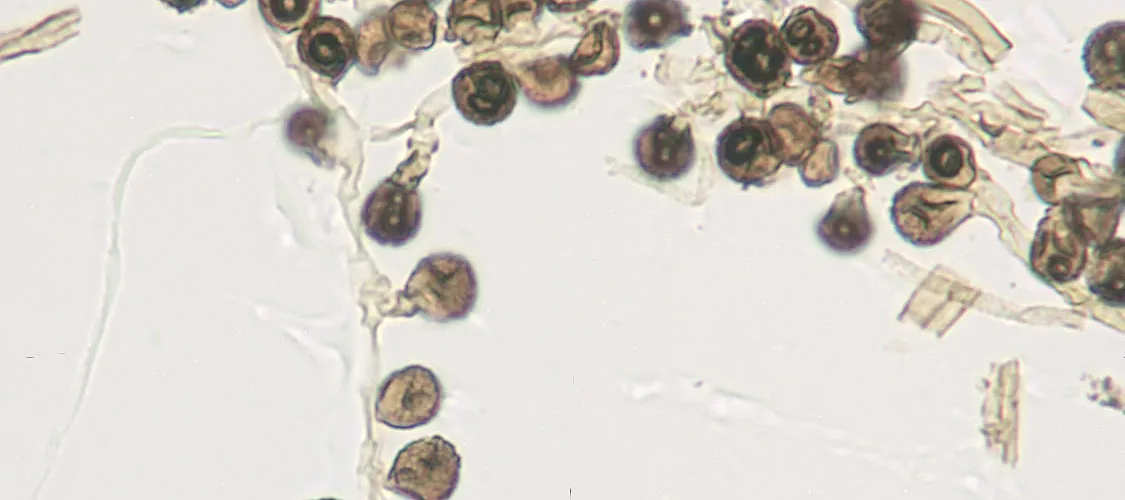
Below: chrysotile; transmission electron micrograph, 75,000x; the fibrils have their normal and constant diameter of ~0.07µm; each fibril is composed of a sheet of Mg-O/Si-O which curves into a many-layered scroll; the empty cores of the scrolls are darker than the edges.
|
||
Choices
An analytical laboratory has many choices to make during an analysis
- choices that affect the accuracy or dependability of the analysis
- choices that affect the cost of an analysis
Fiberquant has has and will never sacrifice accuracy or dependability for cost.
|
Choices in Personnel In microscopy, an analysis is only as good as the analyst performing it. Fiberquant has always collected the very best and brightest people, from their backgrounds - all analysts have at least a bachelor's degree in a relevant science - to their months-long extensive and rigorous training, to their continuing improvement through attendance at technical conferences. Our employees take pride in going the extra mile to give our clients the best that can be done.
|
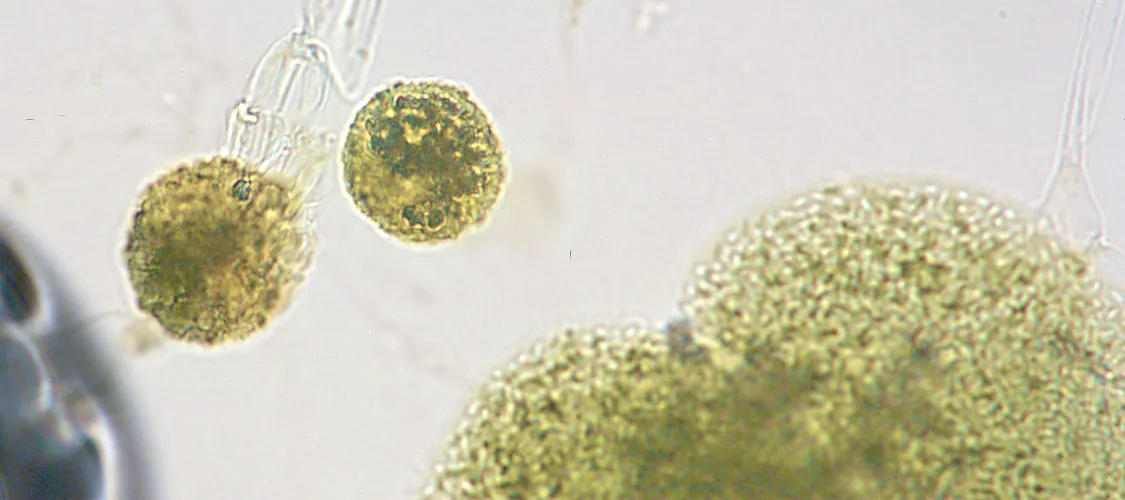
Aspergillus Niger spores two ways. Top: at the limit of what an optical microscope can do (1000x, oil apochromat objective). Bottom: scanning electron micrograph, same magnification. The SEM has far greater resolution that is easily achievable, but unless you take the time and trouble to push optical technique, you would never known that they have maroon stripes over a green core. |
|
Above: measuring the diameter of a TEM beam (full-width at 10% maximum). A line-scan of intensity allows the 10% maximum to be known. |
Choices in Quality Assurance Brilliant analysts, however, are not enough. The analytical system must include an equally brilliant quality assurance (QA) program. Therefore, quality assurance is a large part of a Fiberquant analysis. For every analysis type attempted, a comprehensive QA program has been planned and implemented, including analyst background and training, routine analysis of reference samples, routine calibration and equipment checks, routine re-analysis, analysis of blanks and spikes, the exchange of samples with other labs, and precise record keeping.
|
|
Choices in Procedures We will not compromise the accuracy, precision or dependability of an analysis for the sake of profit. We count fungal spores at 1000x oil-immersion. Even though to count that way is time-consuming, messy, and expensive, we feel the difference is obvious: at any magnification, the dry objective does not have the resolution or contrast to allow the analyst to count, and especially to identify, fungal spores.
|
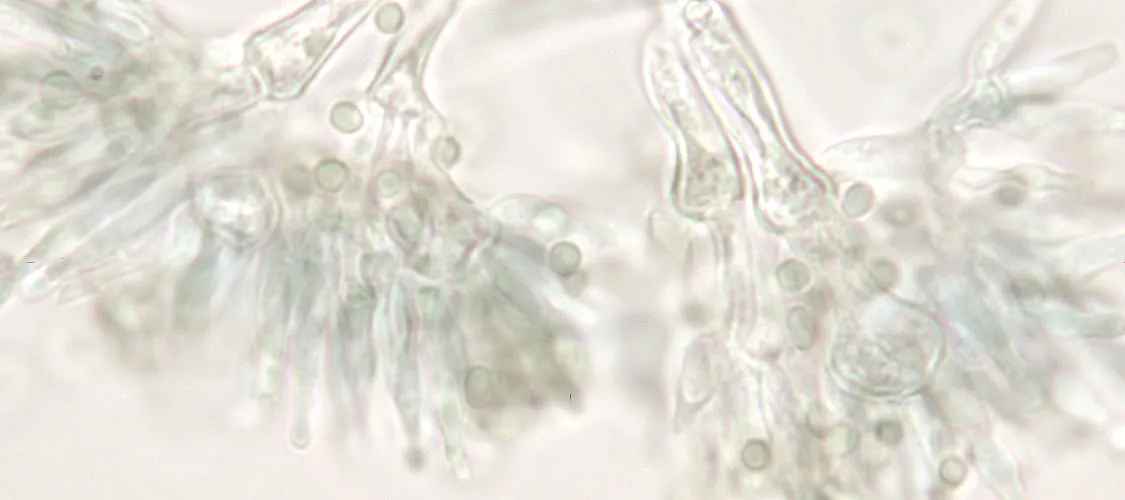
Paecilomyces variotii - same mount photographed two ways. Many laboratories count fungal spores using 400x magnification and an air objective (as in the left-hand photo above). Fiberquant counts spores using 1000x and an oil-immersion objective (the right-hand photo above). Details such as a slightly roughened surface and a certain cell wall thickness may be needed to identify a spore type. |
|
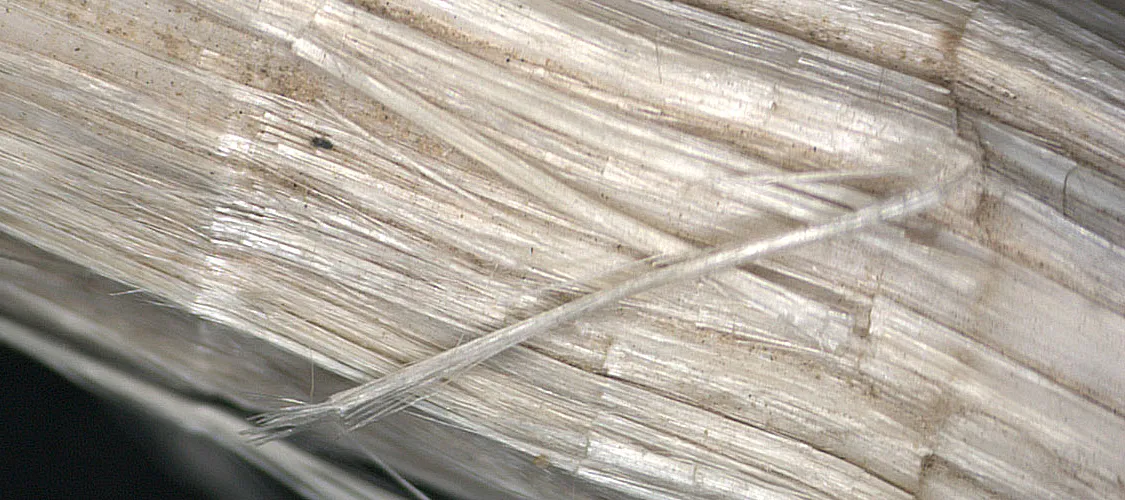
Left: chrysotile, also known as serpentine asbestos, photographed at 200x using phase contrast dispersion staining. Dispersion staining, despite its name, requires no physical stain or dye. It is an optical technique that utilizes the difference in dispersion (refractive index vs. wavelength) between a mineral and the liquid in which it is mounted. This technique allows the refractive indices of a mineral to be calculated. |
Every Procedure has Choices Unlike almost all other laboratories, Fiberquant specializes in phase contrast dispersion staining (PHDS). Its advantages over the usual central stop dispersion staining (CSDS) are 1) PHDS can be easily performed at magnifications of 100, 200 or 400x, rather than just the usual 100x for CSDS; 2) with 400x PHDS, smaller fibers may be seen and characterized than possible with CSDS at 100x; 2) the PHDS working range of wavelengths is narrower than for CSDS, so the refractive indices so calculated are more accurate; 3) the background for PHDS is gray rather than CSDS black, allowing the background matrix to be seen (e.g., for a point-count quantification). |
It is not easy to remain competitive with laboratories who do not share our "quality first" approach to business. We spend more time analyzing your sample than other labs, and so our prices tend to be higher than theirs, but considering the stakes riding on environmental analysis, we feel that we cannot take any other approach.
Fiberquant is run by scientists, not accountants
Accreditations
Why be accredited? In some cases (e.g., AHERA and lead (Pb) analyses), accreditation is required by law. And some customers just assume that if a lab is in business, it is accredited. Beyond that, the accredited lab proves that it is committed (by spending significant time and expense to attain and maintain accreditation) to a level of quality assurance and documentation far above that of non-accredited labs.
NVLAP (#101031) accredited for bulk (PLM) and air (TEM) asbestos analysis; Licensed by Arizona DEQ #00904 for asbestos in water
AIHA-LAP, LLC
(#101593) accredited, IHLAP:
fiber counting (PCM), bulk asbestos
(PLM) analysis;
EMLAP: air (spore trap), bulk and surface direct
examination analysis;
ELLAP: Pb in paint, soil,
wipe
and air matrices (and thus recognized by NLLAP
for same)
Chain-of-Custody
for submitting samples (requires Adobe Acrobat PDF reader,
available at Adobe.com)
Chain-of-Custody in a word processing form to fill out on a
computer
Fiberquant Analytical Services
is
"The Home of the Screaming E-beam"

Fiberquant Analytical Services
5025 S. 33rd St., Phoenix, AZ, 85040
602-276-6139
Copyright 2012 Larry S. Pierce, All Rights Reserved